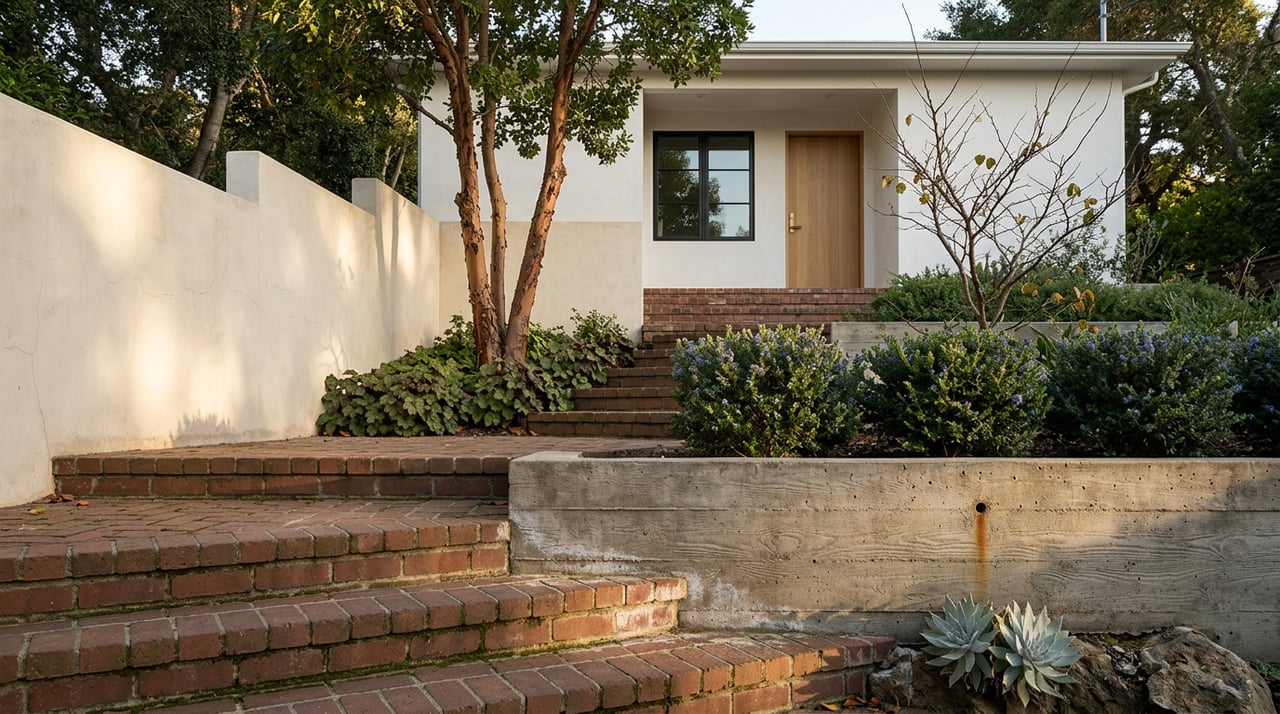
Oakland Hills vs. Flatlands: How Insurance and Zoning Shape the Comparison
August 20, 2026
August 20, 2026
Insurance costs can be an important consideration for buyers looking at hillside homes in Oakland. A quote received during escrow may affect a buyer's budget, even when the loan and inspection are proceeding as expected.
Price per square foot is one way to compare Oakland's hills neighborhoods and flatlands: Montclair versus Fruitvale, or Crocker Highlands versus Downtown. Insurance costs are another factor in comparing total homeownership costs in 2026.
The basic version of this story is familiar to anyone who has spent an afternoon on the portals. Oakland's citywide median sale price sat at $884,000 over the three months ending in May 2026, up 2.8 percent year over year, with homes selling in around 17 days. Move into the hills and the number climbs fast. Montclair's median hit $1.15 million in March 2026, with some sales in the neighborhood closing closer to $1.6 million depending on the block. Crocker Highlands runs as high as $1.8 million. Glenview, sitting between the hill enclaves and the flatlands proper, came in at a comparatively gentle $949,000 in May 2026, and Trestle Glen and Upper Dimond land in the $1.05 million to $1.29 million range.
This comparison focuses on purchase price, while insurance premiums add a recurring cost that can differ between Piedmont Pines and Fruitvale and may not appear in comparable sales.
Much of Oakland's eastern hills, including Montclair, Piedmont Pines, and Oakmore, sit inside Very High Fire Hazard Severity Zones. Standard insurers have been pulling back from those zones for years, which pushes homeowners toward the California FAIR Plan, the state's insurer of last resort. The FAIR Plan only covers fire, smoke, and a handful of related perils. It doesn't cover liability, theft, or water damage, so most owners also need a Difference in Conditions policy layered on top, and that DIC wrap typically adds another 25 to 60 percent on top of the FAIR Plan premium.
Here's what that stack tends to cost once it's assembled:
The California Department of Insurance approved a statewide average FAIR Plan rate increase of 29.1 percent, effective October 15, 2026. That's an average. For policyholders with real wildfire exposure, several sources tracking the filing note the increase runs well past that average, with some wildfire premiums roughly doubling. Anyone in escrow on a hillside property this fall could get quoted one number in August and find a different one waiting at closing in October.
The scale behind that increase is worth sitting with for a second. The FAIR Plan's total exposure reached $768 billion as of June 2026, an 11 percent jump since September 2025 and a 250 percent increase since September 2022. Policies in force climbed to roughly 696,000, up 157 percent over that same four-year stretch.
A house priced $300,000 above its flatland equivalent can still be the better financial decision. A house that can't get insured at all, at any price, isn't a decision. It's off the table.
The San Francisco Standard reported that insurers dropped Parkwoods, a 400-unit condo community in the Oakland Hills near Montclair, in 2023, citing wildfire risk. The complex was built seven years after the 1991 Oakland Hills firestorm and used fire-resistant materials and methods. After the property lost insurance coverage, Fannie Mae and Freddie Mac stopped backing new mortgages there. Units now sit longer and sell for less than their pre-pandemic value, because most buyers, especially first-time buyers who make up the majority of condo purchasers, simply can't get a conventional loan on a property that carries no insurance a lender will accept.
As of August 3, 2026, CNBC reported that Fannie Mae and Freddie Mac eliminated the streamlined limited review process for most condo purchases. A second change is still ahead: CAI Advocacy reports that beginning January 4, 2027, associations will also need to hit a 15 percent reserve funding threshold, up from the current 10 percent. Campbell Property Management says buildings that fall short get flagged as ineligible, sometimes called the condo blacklist.
For a buyer weighing a hillside condo against a flatland one, that's a new and very real variable. Two units can list at the same price and have completely different odds of closing on time, based entirely on whether the building's insurance and reserves clear a bar that has nothing to do with the unit itself.
The mirror image of this story is playing out around Rockridge, which has always been Oakland's answer to the question of whether the flatlands can command hill-level prices. The 12-month median sale price there runs around $1.6 million, competitive with Crocker Highlands and well above most of the true flatlands.
Rockridge's premium has always rested on scarcity: walkable College Avenue, a BART stop at the doorstep of the neighborhood, strong schools feeding Chabot Elementary and Oakland Technical High School. That scarcity also intersects with a state-level zoning change. SB 79, which took effect July 1, 2026, requires cities to allow denser, taller housing near major transit stops, and Rockridge BART is squarely inside that mandate. Rockridge Voice reported that Oakland's City Council spent early 2026 debating whether to temporarily exclude Rockridge, MacArthur, and Ashby from the new density rules while a more detailed alternative plan gets built. A district council member proposed removing Rockridge and two other North Oakland station areas from that exclusion, and the proposal passed on an 11th-hour vote.
None of this establishes that Rockridge's prices will fall. The premium buyers pay there may be affected by changes to zoning under state law, just as hillside prices can be affected by changes in the insurance market.
| Neighborhood type | What drives the median | The variable the median doesn't show |
|---|---|---|
| Hills (Montclair, Piedmont Pines, Oakmore) | Views, lot size, tree cover | FAIR Plan alone: roughly $4,000 to $12,000 a year before any wrap is added; October 2026 rate hike still ahead |
| Hill-adjacent (Crocker Highlands, Trestle Glen, Glenview, Upper Dimond) | School access, walkability to Park Boulevard corridor | Partial fire-zone overlap in some pockets, worth confirming property by property |
| Flatlands-premium (Rockridge) | Transit access, College Avenue retail, school pipeline | SB 79 upzoning risk around the BART station, effective July 2026 |
| True flatlands (Fruitvale, parts of East Oakland) | Affordability, commute distance | Lower insurance friction, but wider price variation block to block |
The old version of this comparison asked what a dollar buys in square footage. The current version has to ask what a dollar buys in certainty. A hillside home in Montclair or Piedmont Pines might be the right call for a buyer who wants the trees and the quiet and is prepared to shop the FAIR Plan and DIC stack early, ideally before removing any contingencies, not after. A Rockridge purchase might be right for someone who wants walkability today and is comfortable that the neighborhood could look different in five to ten years as SB 79 plays out. Neither answer is wrong. The mistake is running the comparison on price alone and finding out about the rest of the story during underwriting.
Does every hills home require FAIR Plan coverage? No. Some properties in the hills still qualify for standard admitted coverage, particularly newer construction with fire-resistant materials and defensible space already in place. The only way to know is to get quotes early in the process rather than assuming either outcome.
Will SB 79 change what a Rockridge home looks like next year? Not immediately. The law took effect July 1, 2026, and Oakland is still working through which parcels get temporary exclusions while a longer-term alternative plan is developed. The zoning framework around the neighborhood is likely to keep evolving over the next several years rather than shifting overnight.
If you're weighing a hills property against a flatlands one and want a second set of eyes on what a specific address is actually exposed to, from insurance zone to zoning overlay, that's exactly the kind of groundwork Salt & Pine Real Estate walks through before an offer ever goes in. Reach out and we'll help you get your home value and a clear read on what you're really comparing.
This article is general information, not legal, tax or financial advice. Consult a qualified professional about your situation.
Stay up to date on the latest real estate trends.


Let us guide you through every step of your real estate journey.